
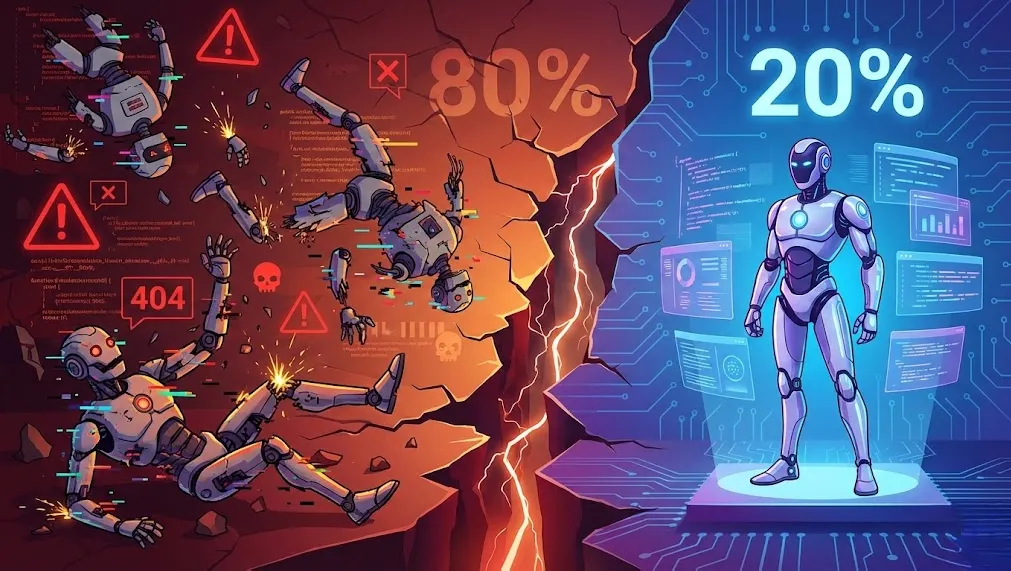
Why 80% of AI Projects Fail (And How to Be in the 20%)
The Three Silent Killers of AI Projects (And How to De-Risk Them)
Introducing Atomic Agents 2.0 - The Enterprise-Friendly Way to Build AI Agents
Control is All You Need: Why Most AI Systems & Agents Fail in the Real World, and How to Fix It
Let’s be honest, the AI graveyard is getting crowded. For every dazzling demo that makes headlines, a dozen expensive, ambitious projects are quietly being buried. We’re three years into this new AI era, and the statistics are grimly familiar. Despite the revolutionary technology, recent reports from analysts like Gartner consistently show that the project failure rate still hovers around a staggering 80% — the same soul-crushing number as the first year.
After two decades leading software projects, I’d hoped we’d have learned our lesson. I’d hoped the mountains of technical debt, the missed deadlines, and the budget overruns had taught us something fundamental about translating a good idea into a great product.
But, helaas, it seems we’re destined to repeat history.
The problem is rarely the technology. AI is already becoming a commodity, accessible to anyone with an internet connection. The failure is almost always rooted in a deeply human problem: a breakdown in translation. A great business vision gets lost in a minefield of vague requirements, technical misunderstandings, and misaligned teams. A board member has a “great idea,” a team grabs some shiny new tech, and a project is born — with no clue who it’s for, how to measure its value, or how it will be maintained.
Then everyone acts surprised when it fails to find a single user.
This new age of autonomous, multi-agent AI systems is a reset button. It’s our chance to apply the hard-won lessons from the past and build things the right way. It’s time to stop the bleeding before it starts.
The Diagnosis: The Three Silent Killers
Before we can prescribe a cure, we have to understand the disease. In my experience, most AI projects don’t die from a single, catastrophic event. They die a slow death, bled out by one of these three silent killers.
Silent Killer #1: The “Shiny Object” Syndrome (The Technology Trap)
You’ve seen it happen. A new model drops, a new framework is trending on GitHub, and suddenly, the entire engineering team is obsessed. They’re captivated by the how long before they’ve even defined the why. The result is always the same: a technically impressive demo that solves a problem nobody actually has.
I recently consulted for a global multinational that was deep in this trap. The team was building a suite of basic agents on their existing, comfortable tech stack. The scope was international, the deadline was tight, and the budget was enormous. But when I asked them how they were measuring the value it would bring to the company, or what specific business friction it was designed to eliminate, I was met with blank stares.
They were so focused on the tech that they’d completely forgotten the user. They were building a solution in search of a problem, a classic recipe for a very expensive failure. We’re seeing this across the industry, with companies rushing to wrap some code around an LLM API, only to see their entire product become a redundant feature when the underlying model gets a simple update.
Silent Killer #2: The “Empty Stadium” Problem (The Adoption Gap)
This is the most heartbreaking failure of all. A brilliant, powerful tool is built… and nobody uses it. It sits on a digital shelf, collecting dust in an empty stadium of non-users.
The problem isn’t just the AI; it’s the arrogance of assuming people will change their entire workflow just because you built something clever. One company spent a reported $500 million to re-skill their workforce for the AI era. Their internal research revealed a sobering truth: out of every 10 employees, only two would actually adopt the new tools. Three would poke at it, and five simply didn’t care.
My observation isn’t just a one-off; it’s a symptom of a massive, industry-wide crisis. A recent Salesforce study, for instance, found that a staggering 62% of workers say they don’t have the skills to effectively use AI today. And it’s a two-sided problem. While employees feel unprepared, a survey by Preply revealed that 45% of companies are struggling to find skilled candidates to even fill their open AI-related jobs.
So you’re not just building for an empty stadium; you’re building for a stadium where most of the audience doesn’t even know the rules of the game. When I see corporate AI training sessions, half the room is scrolling through their phones, completely disengaged. The tools may be revolutionary, but if the people who are meant to use them don’t see the value or lack the skills, your project is dead on arrival.
Silent Killer #3: The “Lost in Translation” Gap (The Human Failing Factor)
How many times have you sat in a meeting, listening to a stakeholder describe a vision, and felt that rising urge to just… strangle someone? Not because they’re a bad person, but because they are physically incapable of communicating their idea in a way the receiving party can understand.
This is where most projects truly die. This is the human failing factor.
In my years of leading projects, the number one killer has always been bad communication. It infects everything: spoken words in meetings, vague emails, confusing slide decks, poorly written technical documents, ambiguous user stories, and uncommented code. It’s a cancer that spreads from the initial vision to the final line of code.
Sometimes it’s not the people, but the process. A rigid, bureaucratic workflow that goes against every principle of Agile or Lean. Security protocols and tool restrictions so tight that they actively frustrate and disempower the very people they’re supposed to help. This creates a gaping chasm between a brilliant vision and a broken execution, and it’s into this chasm that budgets, timelines, and team morale disappear.
The Solution: The “Blueprint-First” Methodology
So, how do we fight back? How do we build a bridge across that chasm?
You start by adopting the mindset of a specialist. A surgeon runs the diagnostics before prescribing the surgery. You don’t start building until you have a rock-solid, de-risked plan — a blueprint.
This isn’t about adding bureaucracy; it’s about adding clarity. The Blueprint-First methodology is designed to systematically eliminate the three silent killers before they have a chance to strike.
To defeat the “Shiny Object Syndrome,” you start with a Process Friction Analysis.
Forget the tech. The first step is to become a detective. We dive deep into the business process and identify the real, quantifiable points of pain. Where is time being wasted? Where are costly errors being made? Where is the human bottleneck? We diagnose the actual business problem first, so the solution is guaranteed to have value.
To defeat the “Empty Stadium Problem,” you conduct deep Stakeholder & User Workflow Mapping.
Before you build a technical system, you must profoundly understand the human system you are integrating it into. We interview the end-users, map their daily workflows, and understand their motivations and frustrations. We build a solution that fits into their world, not the other way around. This ensures the stadium is full on day one.
To defeat the “Lost in Translation” Gap, you deliver a Developer-Ready Blueprint.
This is the ultimate translation document. It’s the perfect, unambiguous set of artifacts that bridges the gap between vision and execution. It includes a Technical Design Document (TDD), a pre-populated and prioritized Jira project, and clear user stories. This blueprint doesn’t confuse the engineering team; it empowers them with the clarity and autonomy they need to build with speed and confidence.
Your Project’s Success Depends On It
Successful AI is not about having the best model or the slickest algorithm; it’s about having the best plan. The biggest risks to your project aren’t technical; they are human.
De-risking your AI initiative with a blueprint isn’t a cost; it’s the single best investment you can make. It’s the insurance policy that guarantees a higher chance of success by ensuring you’re building the right thing, for the right people, in the right way.
So, before you write your next line of AI code, ask yourself: have you built your blueprint?
Your project’s success depends on it.
